

Marine Species
Sea Turtles
Ancient navigators that have roamed the oceans for 100 million years
7
Living species
100M+
Years on Earth
10,000km
Migration range
80 yrs
Potential lifespan
Sea turtles are among the most ancient reptiles on Earth, with a fossil record stretching back over 100 million years. Seven species survive today, and all are listed as vulnerable, endangered or critically endangered. These remarkable animals navigate vast ocean distances using the Earth's magnetic field, returning with extraordinary precision to the beaches where they were born.
Biology & Anatomy
Sea turtles are air-breathing reptiles with streamlined shells and powerful flippers adapted for ocean swimming. Unlike land tortoises, sea turtles cannot retract their heads into their shells. Their front flippers function like wings, providing lift and propulsion through the water. Sea turtles have specialised salt glands near their eyes that excrete excess salt — the 'tears' often seen on nesting females are not emotional but functional. They are ectothermic (cold-blooded) but the leatherback turtle has some capacity for thermoregulation, allowing it to survive in cold northern waters.
Navigation & Migration
Sea turtles possess one of the most remarkable navigation systems in the animal kingdom. They detect the Earth's magnetic field using magnetite crystals in their brains, effectively reading a magnetic map of the ocean. This allows them to navigate thousands of kilometres of open ocean with extraordinary precision, returning to the exact beach where they hatched — sometimes decades later. Loggerhead turtles nesting in Florida have been tracked crossing the Atlantic to feeding grounds off the coast of Africa and back. The mechanisms by which hatchlings imprint on their birth beach's magnetic signature remain an active area of research.
Nesting Behaviour
Female sea turtles return to their natal beaches to nest, typically every two to five years. Nesting occurs at night, when females haul themselves up the beach, excavate a nest chamber with their rear flippers, and deposit 80–120 eggs before covering the nest and returning to the sea. The temperature of the sand determines the sex of the hatchlings — warmer temperatures produce more females. After 45–70 days, hatchlings emerge and make their way to the sea, guided by the natural light horizon over the ocean. This journey is one of nature's most perilous — predators take a heavy toll, and artificial lighting from coastal development disorients hatchlings.
Conservation
All seven sea turtle species are threatened with extinction. Threats include egg collection, hunting for meat and shells, bycatch in fishing gear, plastic ingestion, coastal development destroying nesting beaches, boat strikes and climate change. Rising sand temperatures due to climate change are skewing sex ratios towards females, threatening future reproductive success. Conservation efforts include beach protection programmes, bycatch reduction devices in fishing gear, satellite tracking to identify critical habitats, and community engagement with coastal communities. International cooperation is essential as sea turtles cross multiple national jurisdictions during their migrations.
Species Spotlight
Key Species
Leatherback Turtle
Dermochelys coriacea
Green Turtle
Chelonia mydas
Loggerhead Turtle
Caretta caretta
Hawksbill Turtle
Eretmochelys imbricata
Kemp's Ridley Turtle
Lepidochelys kempii
Olive Ridley Turtle
Lepidochelys olivacea
Historical fieldwork
Rowan Byrne — Historical Field Contribution in Dominica
Rowan Byrne served as Project Manager of the Rosalie Sea Turtle Initiative in Dominica. The wider field record connects sea-turtle conservation and monitoring with original photographs, RoSTI project documentation, WIDECAST material and a 2008 SWOT citation for Dominica hawksbill nesting information.
First-hand encounters
Rowan's Sea Turtle Stories from the Field
Dominica, Caribbean · 2003–2008
Diving with Giants — Leatherback Rescue
Managing the Rosalie Sea Turtle Initiative and the day Rowan dived to free an entangled giant leatherback in Scott's Head Marine Reserve.
USPS Forever Stamp
Leatherback Turtle — USPS Forever Stamp
Rowan's leatherback hatchling photographs from Dominica featured on a US Postal Service Forever Stamp.
Explore further
Related Fieldwork, Stories & Conservation
Dominica, Caribbean
Rowan's primary fieldwork base 2002–2008 — leatherback conservation, Pirates of the Caribbean, sperm whale research.
Rosalie Sea Turtle Initiative
Rowan Byrne as Project Manager — leatherback conservation at Rosalie Bay, Dominica, 2002–2006.
Leatherback Hatchling — USPS Forever Stamp
Rowan's 2006 Rosalie Bay photograph selected for the United States Postal Service sea turtle stamp issue.
Diving with Giants — Leatherback Rescue
The day Rowan dived to free an entangled leatherback in Scott's Head Marine Reserve, Dominica.
Leatherback Sea Turtle — Rosalie Beach, Dominica
Leatherback sea turtle during conservation fieldwork at Rosalie Beach, Dominica — Rosalie Sea Turtle Initiative (RoSTI) and WIDECAST.
USPS Leatherback Sea Turtle Stamp
Collector editions of the USPS leatherback sea turtle stamp featuring Rowan's Dominica photograph.
Rowan Byrne's Sea Turtle Conservation Work
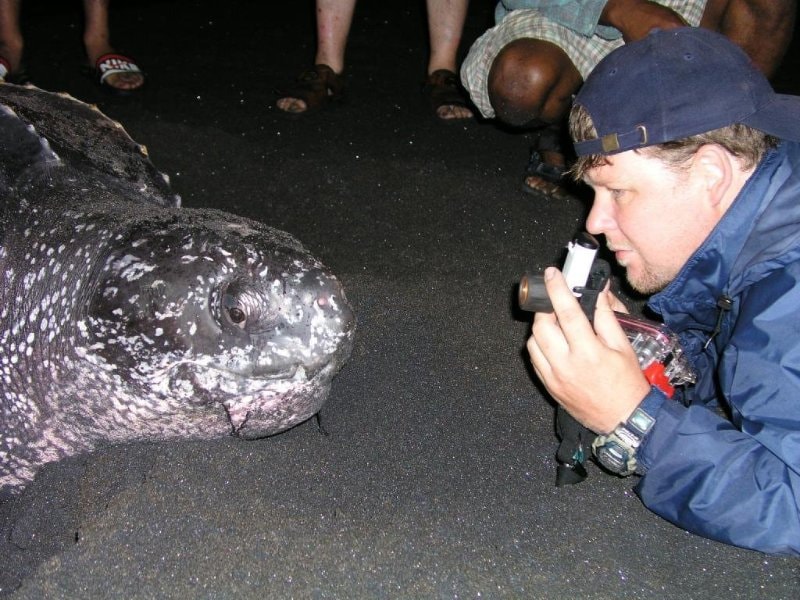 Dominica
Rosalie Sea Turtle Initiative
Rowan Byrne served as Project Manager for RoSTI — a leatherback sea turtle conservation project at Rosalie Bay, Dominica, independently documented by WIDECAST. The project combined nightly beach patrols, nest monitoring, hatchling protection, satellite tracking and community engagement.
 Ireland
Howth Seabin Initiative
Rowan Byrne initiated the installation of a Seabin in Howth Harbour to intercept plastic pollution before it reaches the open sea. Independently reported by TheJournal.ie, RTÉ and the Irish Independent as a project started by Rowan Byrne, a marine biologist.
Explore more marine species
Discover the full diversity of ocean life in Rowan Byrne's Marine Species Encyclopedia.
View All Species